
Ditch the Stress: How to Turn Exam Time into Playtime for Little Learners
Let’s be honest: when you hear the word “exam,” do you feel that familiar tiny clutch in your chest? I do. It’s that instinctive parental worry—we just want our kids to be happy, confident, and… well, not completely overwhelmed.
When our kids are in the 3-8-year-old bracket, the idea of “studying” can seem a bit much. Their main job right now is to learn through play and curiosity. However, schools do introduce gentle assessments and spelling quizzes. The secret to helping them cope is simple: Turn “studying” into a shared adventure. If it feels like a chore, they’ll resist. If it feels like a game, they’ll want to keep going.
Here is a guide to helping your little one thrive…
Creative Techniques for Little Brains
1. Mind Maps (The “Brain Web”)
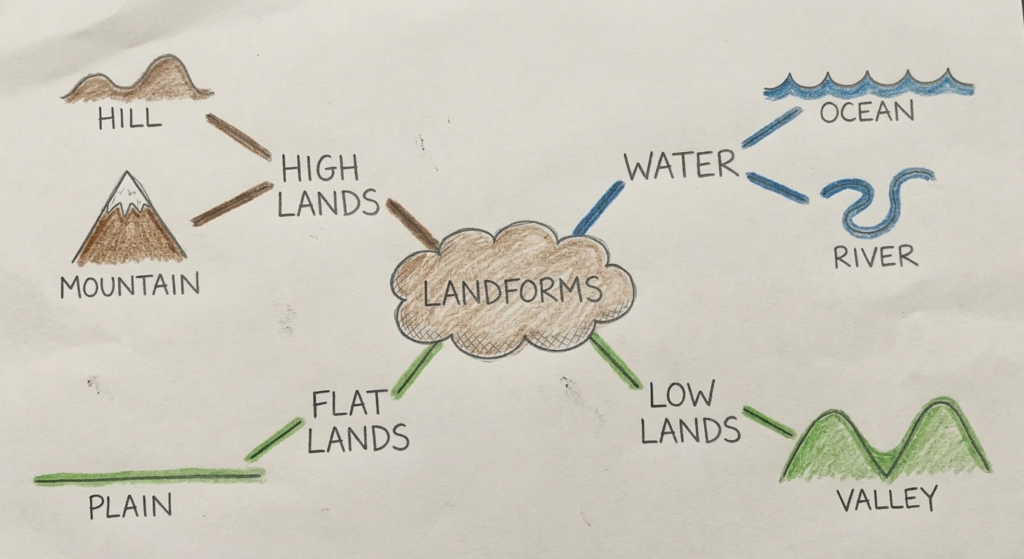
Best for: 5-8 year olds. (For younger kids, you draw, they color). Instead of a boring list, visualize the topic like a tree.
- The Example (Landforms): Put “LANDFORMS” in a big brown cloud in the middle. Draw four thick branches: High Lands, Low Lands, Water, and Flat Lands.
- The Twigs: From High Lands, draw a pointy mountain with a snow cap and a little hill bump. From Water, draw wiggly lines for a river and waves for the ocean.
- The Memory Trick: Use a different color for each branch (Brown for mountains, Blue for water). When they close their eyes during a quiz, they’ll remember the “Blue” side of their drawing!
2. Super-Simple Mnemonics
Best for: 5-8 year olds. Mnemonics are just “silly sentences” that help memory.
- For Directions: Never Eat Sour Watermelon (North, East, South, West).
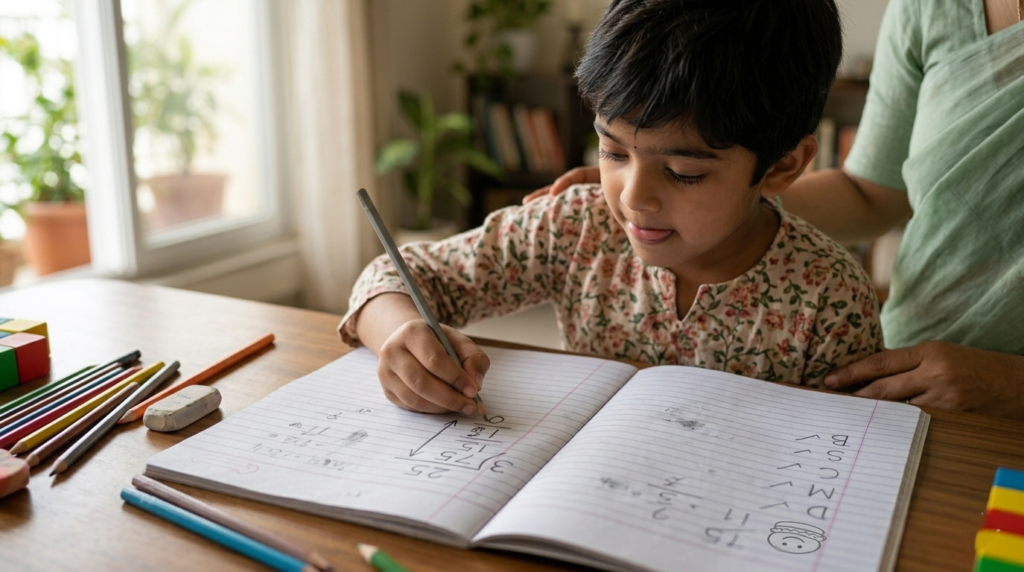
- For Steps in Long Division: Does McDonald’s Serve Cheese Burgers? (Divide, Multiply, Subtract, Check, Bring Down).
3. The “Match-Up” Game (Vocabulary)
Best for: 4-8 year olds. This is my absolute favorite for learning new word meanings.
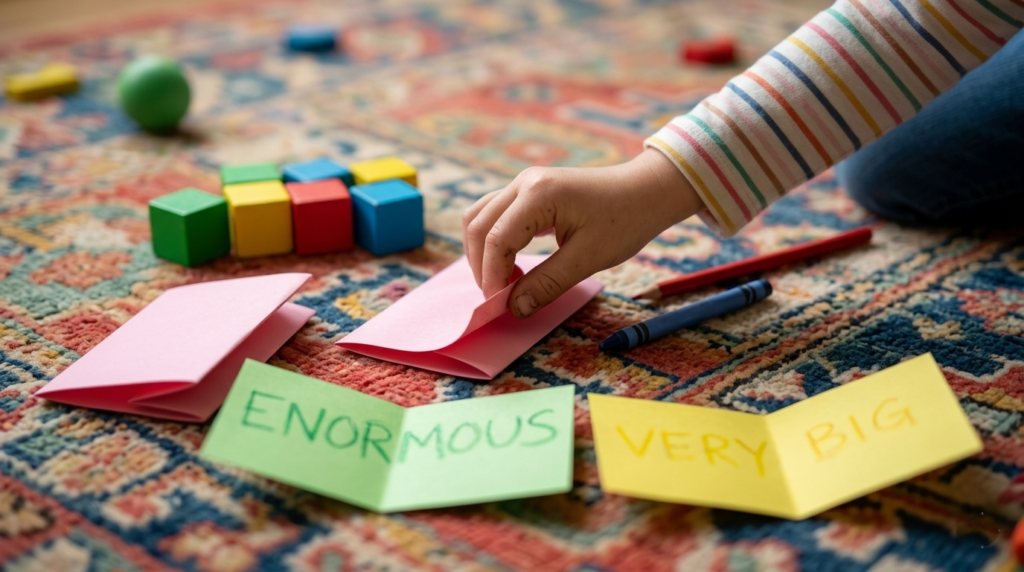
- How to do it: Take colorful paper slips. Write a new word (e.g., “Enormous”) on one and its meaning (“Very Big”) on another. Do the same for all the word meanings. (Keep the number of words to be learnt at a time, suitable to kid’s age)
- The Play: Shuffle the word and meaning slips. Spread them on the floor face down. Your child finds a “partner” by matching the correct word to its meaning, just like a classic memory game!
Don’t forget to cheer up the child when the word is matched with its correct meaning.
4. The Study Jingle
Best for: 5–8-year-olds.
Songs act like ‘brain-glue’—they stick in a child’s memory much longer than a spoken rule. For example, by turning Place Value into a simple rhythm, you’re helping them memorize the columns while they’re busy having fun!”
Try this call-and-response rhyme (clap along!): Its effect increases if the parent and child move and jump together according to the jingle while singing. (You need not be a pro at singing or dancing) ☺
Here you go 🎶
- Parent: “The Ones stay small; they’re on the Right!” (Child repeats)
- Parent: “Take a step Left, what do you see?” (Child repeats)
- Parent: “A group of Ten for you and me!” (Child repeats)
- Parent: “Jump Left again, we’re not done yet!” (Child repeats)
- Parent: “A Hundred is the biggest set!” (Child repeats)
Such type of movement while studying is perfect for ‘Kinesthetic Learning’. We will cover this topic in future discussion.
5. The “Word Slicer” Technique
Best for: 6-8 year olds.
Breaking down long, scary words into smaller “bites” is one of the most effective ways to build spelling confidence. It stops a child from feeling overwhelmed by a string of let’s say ten letters and lets them focus on sounds they already know.
When a word looks too big to handle, teach your child to be a “Word Slicer.” By breaking the word into its natural beats (syllables), they realize that one “giant” word is actually just three or four tiny, easy words hiding together.
- The Method: Have your child clap the “beats” of the word first. For every clap, draw a vertical “slice” line.
- The Example: Retention becomes Re | ten | tion.
Why this works for memory:
Matching a word like ‘Retention’ with its sliced version ‘Re|ten|tion’ allows the child to tackle the spelling in stages. Instead of memorizing nine letters in a row, they only have to remember three small chunks.
Parent Pro-Tip: Start with words they use in daily life. For a 6-year-old, try slicing “Bas-ket-ball”. For an 8-year-old, move up to “Fan-tas-tic”. Keeping the number of “slices” suitable to the child’s age ensures they feel like a master slicer, not a frustrated student!
Beside all these methods, sometimes kids might feel stressed out during exams as they get too much to study altogether for continuous days. The only thing is they don’t understand how to express what they are feeling.
As parents, we need to observe certain behaviour changes that is actually a reflection of the stress. As now, they are getting lesser playtime outside, we need to include playtime during the study time to help them chill.
You Can Help Them Cope Up
1. Validate the “Big Feelings” If they say, “I’m scared I’ll forget,” don’t just say “You’ll be fine.” Try: “It’s okay to feel nervous! Mama/Papa also used to feel the same as a child. But we should just keep trying to do our best… then everything is taken care of!
2. The “Quiet Pause”: Mini-Meditation for Big Feelings

Difficult feelings like “I can’t do this” or “It’s too much” can act like a fog in a child’s brain. If we introduce mini meditations now, we give them a toolkit for life.
- The “Five-Finger Breathing”: Have your child trace their hand. As they slide up a finger, they breathe in. As they slide down, they breathe out. By the time they finish their hand, their heart rate has slowed down naturally.
- The “Balloon Belly”: Tell them to imagine their tummy is a balloon. They need to fill it with air until it’s big and round, then let the air out with a tiny sssss sound.
Why this matters:
Meditation isn’t about sitting still for an hour; for a child, it’s about a 30-second reset. When they hit a wall with a math problem, a mini meditation clears the “emotional fog” so their logic can turn back on. It’s the ultimate stress-free study secret.
Final Thought
It’s important that these techniques are followed regularly and not specifically during exam time. We aren’t trying to create mini encyclopedias. We are trying to build confident, curious explorers.
If they leave these early years feeling that learning is a puzzle they can solve, you’ve given them the greatest gift of all.